Disclosure: Published by La Petite Labs, maker of Hollywood Elixir.
Leap Years review: the short verdict
Leap Years deserves a close look if you are considering a supplement for an older dog's changing behavior. Its two-part NAD-plus-senolytic regimen has a published, placebo-controlled dog trial. The clearest positive result was an improvement in owner-rated cognitive scores at three months. The study did not establish longer life or a general increase in activity. [8]
The everyday purchase is a jar with two kinds of chews: golden chews on two consecutive days each month, then brown chews for the remaining days. Your dog's weight determines the portion and cost. This review explains the study, current ingredient disclosure and routine, then shows where Hollywood Elixir's 17-active cellular-energy and antioxidant system offers a different nutritional choice. [1] [2]
- Leap Years' clearest strength: a controlled study of its proprietary active regimen in senior dogs, with a relevant owner-rated cognitive outcome.
- What to understand before buying: the exact active compounds are not publicly named, the two colors have different jobs, and a large dog's routine uses more chews than a small dog's.
- Our Hollywood Elixir case: NR and CoQ10 with glutathione, antioxidant vitamins and supporting nutrients for several connected parts of cellular nutrition.
Why there are golden and brown chews
Leap Years combines a daily NAD+ precursor with a senolytic given on two consecutive days each month. The current retail system packages that schedule in two colors of beef-flavored soft chew. The golden chews come in a separate bag inside the jar. [9] [10]
| Chew | Declared active amount | Place in the routine |
|---|---|---|
| Golden LY-D6 | 600 mg of the NAD-booster-plus-senolytic combination | Two consecutive days each month |
| Brown LY-D2 | 200 mg of an NAD booster | The remaining days of the month |
The golden 600 mg is the combined amount, not 600 mg of each ingredient. Leap Years says it contains no NMN, but the public descriptions do not name the NAD precursor, the senolytic or the split within the golden combination. Those numbers therefore cannot be converted into an NR or NMN dose comparison. [9]
The color tells you which formula to give; the size directions tell you how much. A Medium dog receives a whole chew, while other sizes receive a different portion. Keeping those two instructions together makes the regimen easier to follow.
What NAD support and a senolytic are intended to do
Food supplies the fuel. As cells break down nutrients, NAD+ accepts electrons and becomes NADH. Those electrons can feed reactions in mitochondria that make ATP, the molecule used to power much of a cell's work. An NAD+ precursor supplies material cells can use to make this coenzyme. It does not supply a second source of calories. [4] [5]
“Food supplies the fuel. NAD+ helps cells move the electrons used to turn that fuel into usable energy.”
The senolytic part addresses a different process. Senescent cells have stopped dividing but remain alive; some release signals that can disturb surrounding tissue. Senescence can have protective roles, too, so it is more specific than simply calling every old cell damaged. Senolytics are intended to help eliminate selected senescent cells by acting on the pathways that keep them alive. [8]
“A senolytic is intended to help remove selected senescent cells: cells that have stopped dividing but can still affect the tissue around them.”
That explains the two-part design. It does not tell us whether the trial dogs actually gained NAD+ or lost senescent cells: the published trial did not measure either. Its useful evidence comes from the outcomes it did measure. Our NAD+ for dogs guide explains the coenzyme and precursor distinction in more detail. [8]
What the published dog study actually found
The 2024 Scientific Reports paper describes a randomized, blinded, placebo-controlled study conducted at North Carolina State University. It enrolled 70 senior dogs with mild to moderate cognitive impairment, assigned to placebo, a low dose or a full dose of the proprietary LY-D6/2 regimen. Fifty-nine dogs entered the primary three-month analysis after withdrawals and exclusions. [8]
Owners completed a cognitive questionnaire covering everyday behavior. Across the first three months, the change in its scores differed significantly between groups, with the full-dose group showing the largest improvement. All three groups improved to some degree. The analysis adjusted for frailty at the start of the study and reported p = 0.02. [8]
| Question | What the paper supports |
|---|---|
| Did owner-rated cognition change? | Yes. The three-month score analysis favored the full-dose group, which improved most. |
| Did dogs become measurably more active? | Activity monitoring did not show a significant difference between groups. |
| Did walking speed or clinic-based cognitive tests improve more? | These measures did not show significant group differences. |
| Did NAD+ increase, senescent cells decrease or lifespan extend? | Those outcomes were not established by this trial. |
The often-quoted “nine in ten” figure needs its full meaning: 16 of 18 full-dose dogs had scores that were stable or improved, compared with 12 of 20 placebo dogs. That separate comparison was not statistically significant. It is different from the positive score-change analysis above, and it does not mean nine in ten dogs improved. The difference in score changes was not maintained from months three to six. [8]
The study used capsules containing the proprietary active regimen, rather than the retail flavored chews, on the daily and two-days-monthly schedule. This is relevant research on the Leap system, with a specific formulation and delivery context. Animal Bioscience funded it; the paper states that the company had no role in data acquisition, analysis or presentation, and the authors declared no competing interests. [8]
Does that study resemble your dog?
The trial dogs were at least ten years old, weighed more than 6 kg (about 13 lb), and already showed mild to moderate cognitive impairment. That is a more specific population than every adult dog whose owner hopes to support healthy aging. It is also different from a study showing that a healthy young dog will stay youthful for longer. [8]
Start with the change you are trying to understand. Is your dog getting lost in familiar rooms, interacting differently or waking at night? A brief record of what happens, when it began and what else changed gives the veterinary team a clearer picture. Pain and other health problems can resemble cognitive changes, so a supplement's marketing description cannot identify the cause. [13]
Three months was the trial's main assessment point, not a deadline by which every dog should respond. It is reasonable to value that evidence while keeping expectations tied to the particular outcome. If nighttime pacing is the concern, our guide to a dog being restless at night explains useful observations and reasons to seek care.
The daily portion and current cost
The current directions say to give Leap Years in the morning, with or without food. Choose the appropriate color for the day and the portion for your dog's current weight. “One chew a day” applies to the Medium band, not every dog. [1] [10]
| Current size band | Daily portion | One-time purchase shown | Price |
|---|---|---|---|
| Small: 11–22 lb | ½ chew | 2-month supply | $59.95 |
| Medium: 23–54 lb | 1 chew | 1-month supply | $59.95 |
| Large: 55–77 lb | 2 chews | 1-month supply | $119.90 |
| X-Large: over 77 lb | 3 chews | 1-month supply | $179.85 |
These are USD prices checked October 5, 2026, before tax and any applicable shipping. The Medium two- and three-month options are $99.95 and $145.95. The three-month bundle therefore costs less than buying three $59.95 one-month packs. The current 17% subscription option reduces the Medium one-month purchase to $49.76, but check the selected renewal interval as well as the supply description. [1]
A Mini option appears in the selector without a corresponding portion in the visible size table. If your dog's weight falls outside the clear bands or exactly between them, confirm the current bottle directions with the brand. The shipping policy lists the continental United States only. [1] [16]
Check the return terms before opening: the current marketing page promises a 30-day refund after trying the product, while the published refund policy says unopened bottles only, requests within two weeks and no refund for dislike of the taste. Ask which terms apply to your order. [10] [11]
Flavor, tolerance and what owner reviews add
A supplement has to fit the dog who will actually eat it. Leap Years says its beef flavor is synthetic and contains no animal protein. The inactive recipe also includes brewer's yeast, starches, flaxseed ingredients, rice bran, lecithin, glycerin and vitamins C and E; its FAQ notes a small amount of gluten from the yeast. A beef flavor description alone does not settle every food-sensitivity question. [9] [10]
The clinical trial found no difference in the prevalence of adverse events between treatment groups and attributed none to LY-D6/2. That is useful six-month tolerability evidence in the dogs studied. The manufacturer separately reports digestive upset, itchiness, agitation, drowsiness and episodes of hind-leg weakness or difficulty walking. Its FAQ acknowledges that reports cannot reliably establish frequency or causation. [8] [9]
Owner discussions include dogs that seemed brighter, dogs whose owners noticed no change, and dogs that refused the chews or developed concerning symptoms. These accounts are useful prompts for attention, but they cannot determine whether Leap Years caused a particular change or how often one occurs. If your dog develops new illness or weakness, pause the supplement and contact the veterinary team rather than treating it as an expected adjustment. [17]
For a practical record, note whether your dog eats the full portion, which color was given and what changed in the rest of the routine. That information is more useful than trying to match your dog to someone else's online success story.
Quality claims and the details you can inspect
Leap Years describes manufacturing and packaging in FDA-registered facilities, production controls and testing in a registered laboratory. Those statements concern the quality process; they are not FDA approval of the supplement or evidence of a particular clinical result. [9]
The public pages reviewed do not name the exact NAD precursor or senolytic, and we did not find a public lot-specific certificate of analysis linked from those pages. This does not prove that Leap Years lacks internal testing or quality controls. If those details matter to your decision, request the active identities and the report for the lot you would receive, including what was tested and by whom. [9]
La Petite Labs' earlier public-transparency assessment scored Leap Years 64.5/100, based on materials assessed May 23, 2026. This historical score measures public verifiability, not effectiveness or safety. The Brand Transparency Rubric explains its scope. The dog trial and the current purchase details above are more useful than treating that number as a health-outcome rating.
Where Hollywood Elixir offers a different choice
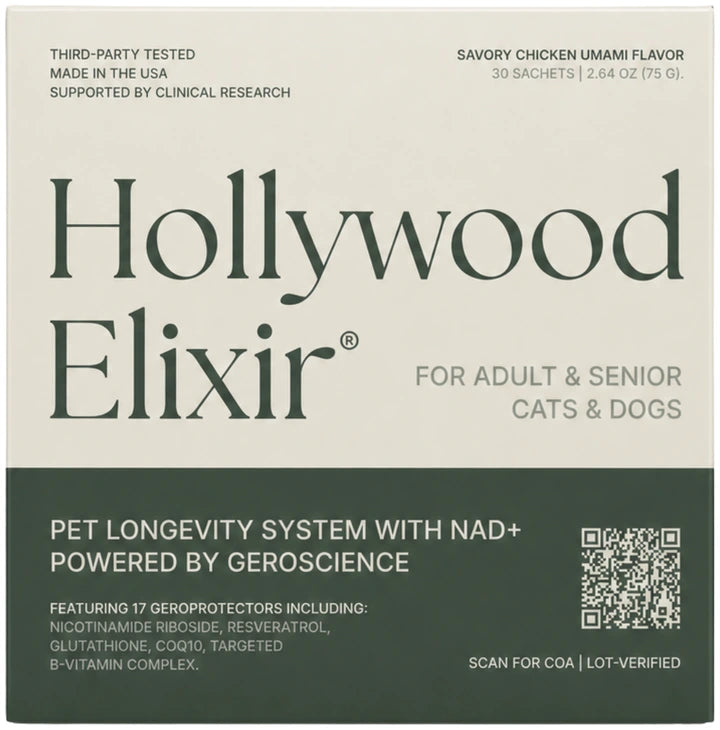
Leap Years is the relevant option when you specifically want its studied NAD-plus-senolytic regimen. Hollywood Elixir is built around a different nutritional purpose: a daily 17-active system for cellular-energy nutrition and antioxidant defenses. Its case rests on the ingredients it brings together and the jobs they are selected to support. [2] [14]
Its NR supplies a starting material for NAD+. CoQ10 carries electrons along the mitochondrial chain involved in making ATP, so it belongs to a different step in energy production. Riboflavin, or vitamin B2, supplies the FMN and FAD coenzymes used in metabolism. These ingredients explain a formulation that reaches beyond the precursor alone. [4] [5] [15]
The antioxidant selection is equally specific. Reduced glutathione helps an enzyme convert hydrogen peroxide into water. Vitamin E helps protect fats in cell membranes by interrupting damaging oxidation chains, and vitamin C can help regenerate vitamin E. Peroxide removal and membrane protection are different tasks within cellular defense. [6] [7]
“Hollywood Elixir pairs cellular-energy ingredients with antioxidants that do different jobs, from removing peroxide to protecting membrane fats.”
Per full 2.5 g sachet, the formula declares 60 mg NR tartrate, 40 mg of a 98% CoQ10 preparation, 50 mg reduced glutathione, 10 mg vitamin C and a vitamin E preparation providing 15 IU. Other B vitamins, resveratrol, quercetin, blueberry and an astaxanthin preparation extend the selection, alongside yeast beta-glucans, reishi, spirulina and whey protein isolate. The full ingredient declaration gives every form and amount, including the specified astaxanthin and B12 preparations. [2]
Leap Years also lists C and E among its inactive ingredients, where the brand describes their role in chew stability. Hollywood Elixir declares amounts for C and E within its active formulation around NR, CoQ10, glutathione and the supporting nutrients. The normal functions described here explain its design; they are not a finding that HE reproduces Leap's cognitive trial result. [2] [10]
A complete-and-balanced food already supplies essential nutrition for its stated life stage. Hollywood Elixir is an optional targeted addition alongside that food, not evidence that the diet has become inadequate. It brings these cellular-energy and protective ingredients together in one food-mixed system, with the daily portion matched to your dog's weight. [3] [12]
For a 25-pound dog, Leap's current Medium three-month offer is $145.95; Hollywood Elixir's Standard 90 pack is $199 for 90 daily sachets. The HE choice is a premium for its different ingredient selection. Our Leap Years versus Hollywood Elixir comparison covers the two routines and value in more detail. For batch documentation, HE's COA Lookup gives access to the relevant records; the current record is a manufacturer-issued quality summary, whose listed tests should be read in their stated scope. [1] [3] [14]
Which routine fits the reason you are buying?
Leap Years makes the strongest case for the owner who gives priority to its studied proprietary NAD-plus-senolytic regimen and can maintain the two-color schedule. Its controlled dog study deserves credit for the owner-rated cognitive result it found. Use the current size directions, the actual repeat cost and your dog's health context to decide whether that is the routine you want. [1] [8]
Bring cellular-energy ingredients and complementary antioxidant defenses into your dog's daily nutrition with Hollywood Elixir. Its 17-active system pairs NR and CoQ10 with glutathione, antioxidant vitamins and supporting nutrients for energy production, peroxide removal and membrane protection. Explore Hollywood Elixir, see the full recipe, and choose the serving plan that fits your dog's food and daily care. [2] [3] [14]
Frequently asked questions
Is Leap Years a legitimate dog supplement brand?
Yes. Leap Years has public product and ingredient information and a published randomized, blinded, placebo-controlled study of its proprietary LY-D6/2 regimen in senior dogs. Those are concrete reasons to take it seriously. The study supports a specific owner-rated cognitive finding, rather than every healthy-aging claim.
What did the Leap Years dog study show?
At three months, change in owner-rated cognitive scores differed significantly between groups, with the full-dose group showing the largest improvement. Activity monitoring, walking speed and clinic-based cognitive tests did not show significant group differences. Seventy dogs enrolled and 59 entered the primary analysis.
Was the study performed on the retail soft chews?
The published methods describe capsules containing the proprietary LY-D6/2 regimen, with an NAD precursor daily and a senolytic on two consecutive days each month. It is research on that active regimen and schedule, not a trial of the retail flavored chew itself.
What are LY-D2 and LY-D6?
LY-D2 is the brown chew, declared as 200 mg of an NAD booster, for the remaining days of the month. LY-D6 is the golden chew, declared as 600 mg of the combined NAD booster and senolytic, for two consecutive days each month. The golden amount is not 600 mg of each ingredient; the portion also depends on dog size.
Does Leap Years contain NMN or NR?
Leap Years explicitly says it does not contain NMN. Its public ingredient descriptions do not name the NAD precursor it does use, so they do not establish that it is NR. The exact senolytic is also not publicly named in the sources reviewed.
How long does Leap Years take to work?
Three months was the main assessment point in the published dog trial. That is a research time point, not a guaranteed response deadline for an individual dog. Record the changes that matter to you and review them in the context of the dog’s health and care.
Which dogs are Leap Years and its study intended for?
The brand markets Leap Years for adult and senior dogs, with portions based on current weight; its how-it-works page says not for dogs under three years old. The trial was more specific: dogs at least ten years old, weighing more than 6 kg, with mild to moderate cognitive impairment. A younger healthy dog does not match that study population.
How much does Leap Years cost?
The current one-time Medium one-month supply costs $59.95; its three-month option costs $145.95. Small has a $59.95 two-month option. Large and X-Large one-month options are $119.90 and $179.85. These are USD prices before tax and any applicable shipping; portion, bundle and subscription choice change the bill.
What side effects have been reported?
The manufacturer reports digestive upset, itchiness, agitation, drowsiness and hind-leg weakness or difficulty walking. Reports do not establish how often the product causes these events. The clinical trial found no difference in adverse-event prevalence between groups and attributed none to LY-D6/2. New illness or weakness warrants veterinary attention.
Does the beef flavor contain animal protein?
Leap Years says it uses a synthetic, non-animal beef flavor and contains no animal protein. Its inactive recipe contains other ingredients, including brewer’s yeast with a small amount of gluten. Check the full recipe against a dog’s known sensitivities; the flavor description is not a blanket allergy guarantee.
Does Leap Years publish batch test results?
The brand describes laboratory testing and manufacturing controls, but a public lot-specific certificate of analysis was not found on the pages reviewed. Ask for the report matching the lot you would receive and check the tests, methods and issuer. This finding does not show that internal testing is absent.
Has Leap Years been shown to make dogs live longer?
No lifespan-extension result was established by the published senior-dog trial. Its clearest positive result concerned owner-rated cognitive scores at three months. The study also did not measure NAD concentrations or senescent-cell clearance.
How is Hollywood Elixir different from Leap Years?
Leap Years uses a proprietary NAD-plus-senolytic schedule with direct dog-regimen research. Hollywood Elixir is a daily 17-active nutritional formula built around NR, CoQ10, glutathione, antioxidant vitamins and supporting nutrients for cellular energy and antioxidant defenses. It is a different formulation and purpose, not a duplicate of the studied intervention.
- Leap Years (n.d.). Leap Years current product and purchase options. Current retail routine, size bands and purchase options.
- La Petite Labs (n.d.). La Petite Labs: Hollywood Elixir ingredient declaration. Current HE forms, preparations and ingredient amounts.
- La Petite Labs (n.d.). La Petite Labs: Hollywood Elixir product and commerce. HE portions and pack prices.
- NIH Office of Dietary Supplements (n.d.). NIH Office of Dietary Supplements: Niacin. Normal NAD-related biochemistry, not a dog efficacy result.
- Reactome (n.d.). Reactome: NADH and CoQ electron transfer. Normal NADH-to-CoQ electron transfer.
- Reactome (n.d.). Reactome: glutathione helps remove hydrogen peroxide. Glutathione-dependent peroxide-removal chemistry.
- Linus Pauling Institute, Oregon State University (n.d.). Vitamin E: antioxidant function. Vitamin E membrane protection and vitamin C recycling.
- Simon KE et al. (2024). A randomized, controlled clinical trial demonstrates improved owner-assessed cognitive function in senior dogs receiving a senolytic and NAD+ precursor combination. Original controlled senior-dog regimen study; specific outcomes and limitations.
- Leap Years (n.d.). Leap Years frequently asked questions. Manufacturer ingredient, tolerance and quality disclosures.
- Leap Years (n.d.). How Leap Years works. Current two-color use, inactive ingredients and marketing guarantee.
- Leap Years (n.d.). Leap Years refund policy. Current written refund restrictions.
- U.S. Food and Drug Administration (n.d.). Complete and Balanced Pet Food. Meaning of a complete-and-balanced pet food.
- American Animal Hospital Association (2023). Managing Cognitive Dysfunction and Behavioral Anxiety. Veterinary assessment of cognitive and behavioral changes.
- La Petite Labs (n.d.). La Petite Labs: Hollywood Elixir guide and COA Lookup. HE system and public batch-record scope.
- NIH Office of Dietary Supplements (n.d.). Riboflavin: normal coenzyme roles. Riboflavin’s normal coenzyme functions.
- Leap Years (n.d.). Leap Years shipping policy. Current shipping territory.
- Reddit r/goldenretrievers participants (2024). Has anyone used LeapYears supplement for their dog?. Self-selected owner questions and experiences; not causal evidence.