Disclosure: La Petite Labs sells Pampered, a daily wellness system that may be relevant to some Fera Pets shoppers. It is not a substitute for Fera's probiotic, mushroom, fish-oil, or single-category products.
Fera is worth a place on the shortlist if you want a supplement from a company with identifiable veterinary contributors and a documented quality program. NASC independently lists it as an audited supplier, and Fera provides a public search tool for product test reports. 9 11
The brand offers powders, chews and oils with meaningful differences between formulas. Its probiotic powder declares a combined microorganism count; the multivitamin chew names a particular strain; the fish oil gives separate EPA and DHA amounts. Choosing among them means comparing those ingredients and amounts, as well as the format your pet will take.
Where the label needs a closer look
The remaining gaps are concrete. The powder’s combined count does not reveal the amount of each organism, and its current ingredient text differs from the pictured label. The mushroom blend gives a total weight rather than individual mushroom amounts. Those details matter when a particular ingredient is the reason you are buying. 2 3 8
There are names and specialties behind the veterinary claim
Fera names five veterinary advisers, including co-founder and CEO Michelle Dulake. Its board also includes Lauren Adelman, a board-certified small-animal internal medicine specialist, and Amy Schnedeker, a board-certified veterinary dermatologist. Matt McGlasson and Hillary Wolfe complete the listed group. 1
The company describes the board’s work as reviewing ingredients and formulations and guiding development. That is more informative than an unnamed “vet formulated” badge. The page does not assign every product to an individual reviewer, however, and a veterinary role is not itself a clinical trial of the product.
The distinctions between credentials matter too. Wolfe is listed as a certified veterinary food therapist; that is not the same title as board-certified veterinary nutritionist. There is no need to inflate the credentials to recognize the expertise Fera actually identifies.
The probiotic powder has a clear total—and a label discrepancy
Fera’s probiotic powder declares 5 billion CFU per 1.2 g scoop, across a blend of 12 named organisms. Its Product Facts image also gives 1.1 g for the prebiotic blend, containing acacia, inulin and FOS. The individual microorganism amounts are not declared. 2 3
There is a specific inconsistency to resolve if you are choosing it for a particular organism: the current Product Facts image lists Bifidobacterium animalis, while the product page’s ingredient text lists Enterococcus faecium in its place. Neither list supplies identifying strain codes. Confirm the label on the product you will receive if that distinction affects your purchase.
This matters when replacing a probiotic recommended for a specific purpose. Seeing a familiar species name—or a larger total count—does not establish that two products contain the same studied microorganism.
Five billion CFU does not mean five billion of each organism
CFU, or colony-forming units, is a measure of viable microorganisms. In a blend, the total does not reveal how that count is divided. You cannot divide by 12 and assume each organism contributes an equal share.
A strain is a more specific identity within a species. That extra identifier helps connect a label to the research. ISAPP’s label guidance explains why a species name and a combined count leave that connection incomplete. It also cautions that more strains or a higher count do not automatically make a probiotic more effective. 4 13
For a buyer, the useful comparison is the microorganism, its amount and the benefit studied together. A bigger number alone cannot tell you which product will be more useful for your pet.
The multivitamin names a strain with a real dog study
Fera’s Multivitamin Soft Chews identify Bacillus subtilis DE-CA9 and link to a published canine study. This is a more traceable research connection than the species-only list on the powder. 5
The 2023 study followed ten healthy beagles for 45 days: six received one billion CFU daily and four received placebo. Clinical examinations and routine blood measurements stayed within reference ranges. Some markers of oxidative damage decreased, but stool scores did not differ significantly between groups. The dogs started healthy; this was not a trial treating diarrhea. 6
That gives the strain a useful piece of canine research without turning it into proof of everything the multivitamin promises. The experiment tested the probiotic in capsules, not Fera’s finished chew with its other ingredients. It was funded by ADM Deerland Probiotics and Enzymes.
Fish oil is easier to compare when EPA and DHA are separate
Fera’s fish oil states minimum amounts of 700 mg EPA and 400 mg DHA per teaspoon. Those are the two named fatty acids a buyer can compare with another oil, rather than comparing only bottle size or the total weight of fish oil. The teaspoon is the label’s measurement basis; use the product’s directions for your pet’s actual serving. 7
Two practical details may matter as much as the bottle price. Fera now says it has removed the pump in favor of a different dispenser, so an older complaint about the pump may describe earlier packaging. It also instructs owners to refrigerate the oil and use it within three months of opening. A larger bottle offers less value if much of it remains when that window ends.
The mushroom label gives the blend’s weight, not ten separate doses
The mushroom Product Facts panel declares 500 mg for the whole blend per scoop, with ten mushrooms listed. It does not mean 500 mg of each, and it does not disclose the amount of an individual mushroom such as turkey tail. 8 14
Fera describes the ingredients as fruiting-body extracts and directs buyers to the COA lookup for their batch’s beta-glucan content. That is a useful distinction between the blend’s weight and a measured component within it. If your reason for buying is a particular mushroom or extract studied elsewhere, the combined amount will not establish an equivalent serving.
The NASC seal and the COA answer different questions
NASC confirms that Fera earned permission to display its Quality Seal after an independent audit. The program requires quality-control procedures, complaint and adverse-event reporting, labeling standards and participation in random independent testing for label claims. It describes an ongoing quality system. 9 10
Fera’s public COA search accepts a lot number or product name. A certificate of analysis is the more specific record: it can identify a sample, the tests performed and their results. Match the product and lot before treating a report as evidence about your bottle. The presence of a lookup does not establish that every certificate covers every possible contaminant. 11
Fera names Eurofins for its fish-oil batch testing; the broader transparency page refers to certified third-party laboratories. The fish-oil statement should not become a claim that Eurofins performs every test across the catalog. We reviewed the public disclosures and labels for this article; we did not retrieve and independently evaluate a certificate for a purchased lot. 7
What the powder costs—and what a review can show
Fera displayed a regular price of $29.95 for the probiotic powder on September 7, 2026. With 60 declared scoops, that is about $0.50 per scoop, before shipping, tax or discounts. Multiply by the amount in the directions that apply to your pet, rather than assuming the jar represents 60 days for every household. 2 11
Fera also explains that the jar intentionally has spare room for its scoop. Its declared contents and serving measure are more useful for assessing value than the height of the powder in the jar. 2
For everyday handling, a first-person review can add something a label cannot. Vetstreet’s Sarah Dodd describes mixing the powder into food for two dogs, including the powder left behind in dry-food bowls. The article discloses affiliate links. Those observations help a reader picture administration; its two-dog experience cannot establish how often another pet will benefit. 12
About the historical 75/100 score
Fera received 75/100 in the May 23, 2026 public-transparency audit recorded on this page. That score concerns disclosure under the Brand Transparency Rubric, not a 75% chance of benefit or a safety rating.
The score has not been recalculated for this September reading. The dated audit and the current product details serve different purposes. The Brand Transparency Report provides the wider historical comparison.
Where Pampered fits the comparison
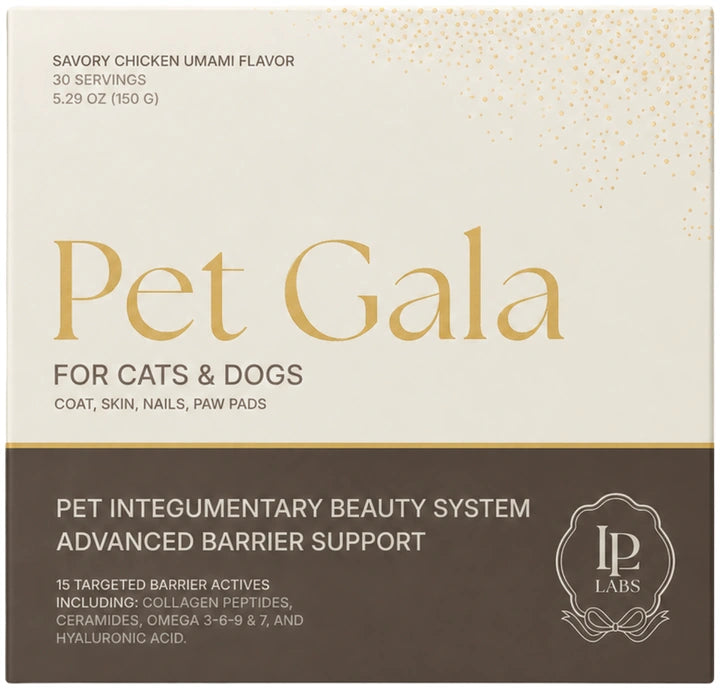
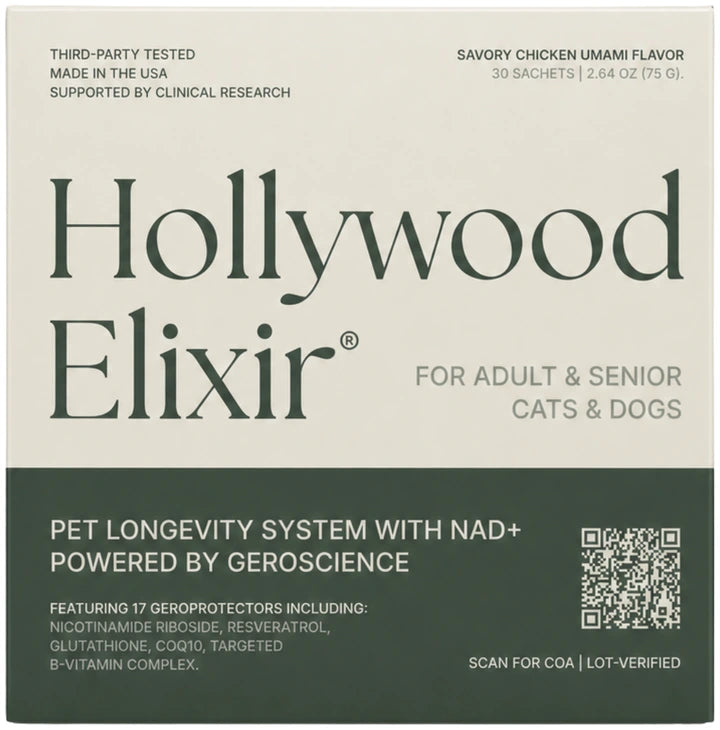
Fera’s range lets you shop for individual categories. Our Pampered™ System makes a broader daily routine easier to understand: Hollywood Elixir for NAD+ and healthy-aging nutrition, paired with Pet Gala for skin, coat and barrier nutrition.
Hollywood Elixir’s 17 actives bring NAD+ building blocks together with energy-related and antioxidant ingredients. Pet Gala combines protein-derived ingredients, lipids, ceramides and hydration nutrients around the skin beneath the fur. You get two complete formulas with distinct purposes, each in its own sachets, rather than having to assemble that routine from several unrelated products.
That is where the pairing earns consideration. It is not a substitute for a prescribed probiotic strain or a specified EPA-and-DHA amount. For healthy-aging and skin-and-coat nutrition together, explore the two formulas and their serving directions, then inspect our quality and testing information. The contents, their rationale and the available documentation should make the choice intelligible.
Should you choose Fera?
Fera offers credible reasons to consider it: named veterinary expertise, independently documented quality controls and useful amounts on several labels. The unanswered details are specific enough to check against the purchase you are making.
For the probiotic powder, the identity of the organisms matters as well as the count. For fish oil, the fatty-acid amounts and the opened-bottle window matter. For a mushroom blend, a combined weight cannot stand in for an individual extract’s amount. Choose the product on those terms, and the brand name becomes a starting point for a much clearer decision.
Frequently asked questions
Is Fera Pets a legitimate supplement company?
NASC independently lists Fera as an audited supplier, and the company identifies five veterinary advisers. These are verifiable credentials; the choice of product still depends on its ingredients and your pet’s needs. 1 9
Is the probiotic powder the same as the probiotic in the multivitamin chew?
No. The powder is a blend with a combined count and no listed strain codes. The Multivitamin Soft Chews name Bacillus subtilis DE-CA9. Their labels describe different formulations. 2 3 5
Does a larger CFU number make a probiotic better?
Not by itself. The microorganism, amount and studied benefit need to fit the comparison. A blended total does not show the amount of each organism or establish equal shares. 4 13
Does Fera publish COAs?
Fera provides a public search by product name or lot. This review did not independently evaluate a certificate for a purchased lot. Match any report to the product and lot, then read which tests it contains. 11
Does Fera fish oil still use a pump?
The current product page says the pump has been removed in favor of a different dispenser. Check which packaging a review describes when using it to judge the product. 7
Does the mushroom powder contain 500 mg of every mushroom?
No. The panel gives 500 mg for the combined blend per scoop. It does not disclose separate amounts for each of the ten mushrooms. 14
What does the 75/100 score mean?
It is the page’s historical May 23, 2026 public-transparency audit score. It has not been recalculated here and is not a measure of safety, effectiveness or the chance that your pet will improve.
When is Pampered a relevant alternative?
When you want to compare a broader daily routine covering healthy-aging and skin-and-coat nutrition. It pairs Hollywood Elixir and Pet Gala. A purchase centered on a specific probiotic or fish-oil amount needs a more direct ingredient comparison.
Sources reviewed
- Fera Pets veterinary advisory board
- Fera Pets: USDA Organic Probiotics with Prebiotics
- Fera probiotic powder: Product Facts panel
- ISAPP: Decoding a Probiotic Product Label
- Fera Pets: Multivitamin Soft Chews for Dogs
- Allenspach et al. (2023): Bacillus subtilis DE-CA9 in healthy dogs
- Fera Pets: Fish Oil
- Fera Pets: USDA Organic Mushroom Blend
- NASC: Fera Pets audited supplier listing
- NASC Quality Seal requirements
- Fera Pets: transparency and COA search
- Sarah Dodd: Fera Pet Probiotics Review, Vetstreet
- ISAPP: Are all probiotics the same?
- Fera mushroom blend: Product Facts panel