


Devon Rex lifespan and senior care
How Long Do Devon Rex Cats Live?
9–15Years, typical
Devon Rex aging is easy to miss when a social cat still asks for attention. Track weight, skin, coat, ears, teeth, movement, appetite, and routine engagement.
- Start watching at
- From 7 years
- Senior age
- 10+ years
- Typical lifespan
- 9-15 years
PetMD gives Devon Rex cats an average 9 to 15 year lifespan; use that as a planning range, not a promise for one cat.
Quick Answers for Pet Parents
Direct answers to the questions people ask when they are trying to plan care.
How long do Devon Rex cats live?
A practical planning range is about 9 to 15 years. Devon Rex healthspan planning should focus on body condition, skin and coat care, ears, dental comfort, mobility, heart signs, and senior screening.
What is the average Devon Rex life expectancy?
Use 9 to 15 years as owner guidance rather than a guarantee. One Devon Rex can vary with genetics, indoor safety, dental care, body condition, mobility, and veterinary findings.
When is a Devon Rex considered senior?
Cats older than 10 are senior under AAHA/AAFP guidance. Start structured Devon Rex tracking around 7 because weight, social behavior, skin, ears, and movement can change gradually.
What Devon Rex cat health problems should owners watch?
Watch skin and coat problems, ear odor or debris, dental disease, HCM or breathing signs, kidney signs, hip or kneecap pain, weight change, grooming decline, and quality-of-life changes.
What most affects Devon Rex healthspan?
Healthy body condition, gentle grooming, ear and dental care, indoor safety, mobility support, senior diagnostics, and fast attention to appetite, breathing, or social change matter most.
Lifespan at a Glance
The short answer with the context a careful pet parent needs.
| Typical lifespan | Use 9 to 15 years as a practical Devon Rex lifespan range, then adjust for the individual cat's health history. |
|---|---|
| Evidence caveat | Modern cat life-table evidence helps with context, but this page should not turn a breed range into a forecast. |
| Devon Rex senior timing | Cats older than 10 are senior under AAHA/AAFP guidance; start Devon Rex baselines around 7. |
| Earlier watchpoint | Track appetite, weight, body condition, skin feel, coat changes, ear debris, dental breath, jumping, grooming, and social interest. |
| Breed-specific priority | A people-focused rex cat may keep seeking attention while skin, mouth, mobility, or heart signs are changing. |
| Do not normalize | Weight drift, greasy or irritated skin, ear odor, bad breath, coughing, breathing effort, lower jumps, or fading social routines. |

You can’t slow the clock. You can change what happens while it runs.
9-15 years is the range. What fills those years — lean condition, easy movement, steady digestion, good sleep — is built one ordinary day at a time.
Start the daily system → Starting at $50/month
If your Devon Rex still follows you from room to room but now has greasy skin, ear odor, stronger breath, a smaller appetite, lower jumps, more sleep, or less interest in shoulder-level mischief, the lifespan question is about daily comfort.
The direct answer: Devon Rex cats are best planned around 9 to 15 years. Some individuals may outlive that range, but a good plan does not wait for the birthday number. It watches the coat, skin, ears, teeth, weight, mobility, breathing, and social routine that make this cat recognizable.
Devon Rex aging is tricky because affection can mask illness. A cat who still wants to sit close may be coping with dental pain, itchy skin, sore hips, kidney changes, or breathing effort. The question is not only whether the cat is present; it is whether being present still looks comfortable.
If You Only Have Five Minutes
- Use 9 to 15 years as the practical Devon Rex lifespan range, then individualize with your veterinarian.
- Cats older than 10 are senior under AAHA/AAFP guidance; begin Devon Rex baselines around 7.
- Track skin feel, coat changes, ear odor, dental breath, appetite, weight, body condition, jumping, grooming, and social engagement.
- A rex coat can make skin changes visible, but it can also tempt owners to over-bathe; use gentle care and veterinary guidance.
- Coughing, breathing effort, fainting, sudden hind-limb pain, lower jumps, poor squatting, or pain after movement should not be minimized.
- Open-mouth breathing, blue-gray gums, collapse, severe weakness, repeated vomiting with weakness, or little/no urine is urgent.
The cat lifespan methodology explains why breed ranges are not predictions. The senior cat signs guide is useful when social behavior changes but the cat still looks engaged.
Why Lifespan Numbers for Devon Rex Cats Don't Agree
Devon Rex lifespan numbers vary because breed profiles, primary-care datasets, and owner anecdotes measure different things. A breed guide may give a practical range. A life-table estimates population survival from records. Neither can replace an exam for the cat in your lap.
Modern UK cat life-table work is helpful background, especially because it keeps the conversation evidence-based instead of folklore-based. It should not be stretched into a Devon Rex-only forecast when this page does not have a clean Devon Rex cell to quote.
That is why 9 to 15 years is a planning tool. It tells you when to prepare senior routines, not when to accept decline. A nine-year-old Devon Rex with coughing, weight loss, or ear pain needs care; a 14-year-old who eats, moves, grooms, and seeks people comfortably deserves individualized optimism.
The most useful lifespan number is the one you can act on: weight trend, mouth comfort, skin comfort, mobility, heart and breathing signs, litter evidence, and whether the cat still chooses people without acting burdened by the body.
What Shapes a Devon Rex's Healthspan
Devon Rex healthspan is shaped by skin and coat comfort, ear health, dental care, body condition, heart and breathing signs, kidney and urinary monitoring, mobility, social engagement, and calm senior screening.
Skin and rex coat
The rex coat makes this breed visually distinctive, but the health question is comfort. Greasiness, redness, dandruff, sores, overgrooming, touch sensitivity, sudden thinning, or a coat that feels different from this cat's normal deserves notes.
Gentle grooming is better than aggressive scrubbing. If bathing is part of the routine, ask your veterinarian how often it makes sense for this cat's skin, because too much handling can irritate fragile coat and skin.
Ears and face
Large ears make change easier to notice. Odor, discharge, redness, head shaking, scratching, pawing, or pain should not be answered with endless home cleaning. The cause may be infection, inflammation, mites, allergy, or another problem that needs diagnosis.
Face and ear sensitivity can also overlap with dental pain. If the cat dislikes touch around the head, changes grooming, or stops enjoying familiar contact, include ears and mouth in the same conversation.
Dental comfort
Bad breath, drooling, red gums, dropped food, slower chewing, one-sided chewing, face sensitivity, or hiding after meals should prompt dental review. Eating with enthusiasm does not prove the mouth is comfortable.
Because Devon Rex cats can be extremely people-oriented, dental pain may show as irritability during cuddling, less play with carried toys, or a cat who approaches food but leaves pieces behind.
Body condition and appetite
Small cats can still carry too much weight or lose important muscle. Use the scale, rib feel, waist, thigh muscle, appetite notes, treat count, and play stamina instead of guessing from the cat's frame.
Rex cats with strong food interest need measured meals. A cat who begs more but loses weight, or eats less and hides, may need thyroid, kidney, dental, gastrointestinal, pain, or stress evaluation.
Heart and breathing signs
Hypertrophic cardiomyopathy belongs in Devon Rex planning. Owners do not need to diagnose heart disease, but they should respect coughing, breathing effort, exercise intolerance, fainting, severe weakness, sudden hind-limb pain, or rapid decline.
Open-mouth breathing is not a watch-and-wait sign. If breathing looks hard, film only if it is safe and does not delay care.
Kidney and urinary evidence
Increased thirst, larger urine clumps, appetite change, vomiting, constipation, accidents, blood, repeated box trips, or straining deserves attention. Kidney and urinary issues are easier to evaluate when you bring dated litter notes rather than memory.
For an older Devon Rex, ask how bloodwork, urinalysis, blood pressure, and weight trend should be used together. One normal-looking day at home does not erase a month of larger clumps.
Mobility and comfort
Lower jumps, avoiding stairs, poor squatting, missed landings, less play, or grooming trouble can reflect pain, weakness, weight change, hip or kneecap discomfort, arthritis, or another illness. Do not require a dramatic limp.
Make the home easier without making it dull: low warm beds, stable steps, secure perches, nonslip routes, and play that keeps the cat engaged without forcing painful leaps.
Social routine as a health sign
A Devon Rex often builds the day around people. Less greeting, more clinginess, irritability, hiding, nighttime calling, sleeping apart, or staying close but disengaged can all be health data.
Compare against this cat's normal shadow pattern. If the cat used to supervise breakfast, keyboards, laundry, and bedtime but now skips one route, write it down.
What Aging Looks Like in a Devon Rex
Devon Rex aging may look like a coat that feels oilier or thinner, ears that need more attention, stronger breath, slower meals, a heavier or lighter body, bigger urine clumps, lower jumps, less shoulder-climbing, less grooming, more sleep in warm places, or a cat who wants contact but not handling.
Ask the daily-life version:
- Does the cat still choose the same people at the same times?
- Are skin, coat, ears, or mouth different from two months ago?
- Is appetite steady, or is food interest masking weight loss?
- Are jumps, stairs, litter squats, and landings still comfortable?
- Are urine clumps, stool, thirst, or accidents different?
- Is grooming complete, or are the back and rear harder to maintain?
Normal aging can make a Devon Rex more heat-seeking and selective. It should not excuse breathing distress, fainting, rapid weight loss, untreated mouth pain, painful ears, urinary straining, or a cat who stays near people while clearly uncomfortable.
When to Call a Veterinarian
Go now for open-mouth breathing, labored breathing, blue or gray gums, collapse, fainting, seizure, sudden hind-limb pain or paralysis, sudden blindness, severe weakness, repeated vomiting with weakness, uncontrolled bleeding, suspected toxin exposure, or repeated litter-box trips with little or no urine.
Book a visit for appetite change, weight drift, vomiting, increased thirst, larger urine clumps, constipation, bad breath, drooling, ear odor, head shaking, skin redness, sores, coat thinning, lower jumping, poor squatting, hiding, irritability, or social routines that fade.
Bring weight history, diet and treat details, skin and ear notes, photos if useful, litter observations, dental signs, safe videos of movement or breathing, medication and supplement lists, breeder or rescue records, and a timeline of social changes.
For later-life comfort decisions, the cat quality of life scale helps organize the discussion. For a Devon Rex, include skin comfort, warmth, touch tolerance, appetite, pain, mobility, grooming, sleep, litter-box dignity, anxiety, and whether closeness still seems enjoyable.
How Devon Rex Cats Compare With Similar Breeds
Devon Rex cats sit with rex comparisons such as Cornish Rex, Selkirk Rex, and LaPerm, but the coat genetics and care details are not interchangeable. The shared lesson is to watch skin, grooming, warmth, body condition, and comfort instead of treating curl as cosmetic.
Compared with Persians, the daily burden is usually less about heavy coat and flat-face anatomy and more about skin, ears, teeth, movement, and social routine. Compared with Abyssinians, the activity signal may be less acrobatic and more people-centered.
Use the cat lifespan by breed hub for the library-wide map. In this home, the real Devon Rex comparison is whether the cat still seeks contact with a comfortable body.
Questions for Your Breeder, Rescue, or Veterinarian
For a breeder or rescue:
- What lifespan, early deaths, HCM, PKD, hip dysplasia, kneecap problems, dental disease, skin issues, ear problems, and appetite patterns are known in close relatives?
- Were heart, kidney, or relevant genetic tests performed, and can records be shared?
- Has this cat ever had skin infections, ear treatment, dental procedures, coughing, fainting, urinary signs, or mobility problems?
- What grooming, bathing, feeding, litter, and social routines kept this cat most comfortable?
For your veterinarian:
- What body condition score should this Devon Rex maintain?
- Do the skin, coat, ear, dental, weight, or litter changes suggest diagnostics now?
- Should heart findings, blood pressure, kidney markers, urinalysis, dental review, or pain assessment be updated?
- Could lower jumps, poor squatting, or grooming decline be pain?
- Which social changes should trigger a same-week appointment?
A Devon Rex with unknown history starts with the basics: weight, mouth, skin, ears, urine, mobility, breathing, and the social routines the cat actually keeps. After that, every change has a baseline.
Sources
- PetMD. Devon Rex Cat Breed Health and Care. https://www.petmd.com/cat/breeds/devon-rex
- Teng KT, Brodbelt DC, Church DB, O'Neill DG, et al. Life tables of annual life expectancy and risk factors for mortality in cats in the UK. Journal of Feline Medicine and Surgery. https://journals.sagepub.com/doi/10.1177/1098612X241234556
- O'Neill DG, Church DB, McGreevy PD, Thomson PC, Brodbelt DC. Longevity and mortality of cats attending primary care veterinary practices in England. https://pmc.ncbi.nlm.nih.gov/articles/PMC10816413/
- AAHA/AAFP. 2021 Feline Life Stage Guidelines. https://catvets.com/resource/aaha-aafp-feline-life-stage-guidelines/
- Cornell Feline Health Center. The Special Needs of the Senior Cat. https://www.vet.cornell.edu/departments-centers-and-institutes/cornell-feline-health-center/health-information/feline-health-topics/special-needs-senior-cat
- Cornell Feline Health Center. Hypertrophic Cardiomyopathy. https://www.vet.cornell.edu/departments-centers-and-institutes/cornell-feline-health-center/health-information/feline-health-topics/hypertrophic-cardiomyopathy
- Cornell Feline Health Center. Polycystic Kidney Disease. https://www.vet.cornell.edu/departments-centers-and-institutes/cornell-feline-health-center/health-information/feline-health-topics/polycystic-kidney-disease
Healthspan by Life Stage
Know what to track before senior age, not only after decline appears.
Set the handling baseline
Collect breeder or rescue records, genetic tests if available, heart and kidney notes, diet history, skin and coat pattern, ear cleaning needs, dental notes, and normal social behavior.
Keep the busy social cat measurable
Use measured meals, daily play, gentle coat handling, toothbrushing practice, ear checks, parasite control, and predictable routines so changes are obvious.
Start the Devon Rex health file
Track weight, body condition, appetite, vomiting, thirst, litter clumps, skin feel, coat thinning, ear odor, dental breath, jumping, grooming, and social interest monthly.
Ask for senior diagnostics and comfort review
Discuss bloodwork, urinalysis, blood pressure, dental timing, heart findings, pain review, thyroid and kidney screening, and whether mobility or skin care should change.
Score comfort, not cuteness
Judge appetite, hydration, breathing, pain, mobility, grooming, skin comfort, litter-box dignity, sleep, anxiety, social contact, and treatment burden together.
Breed Health Map
The main breed-specific topics that can shape lifespan, comfort, and quality of life.
Rex texture needs gentle monitoring
Devon Rex cats can have delicate curly coats and visible skin changes. Watch greasiness, redness, dandruff, sores, overgrooming, sudden coat thinning, or a cat who dislikes touch.
Large ears make changes easy to see
Ear odor, discharge, redness, head shaking, scratching, pawing, or pain deserves a veterinary conversation rather than repeated home cleaning.
Mouth pain can hide behind affection
Bad breath, drooling, red gums, dropped food, slower chewing, one-sided chewing, face sensitivity, or hiding after meals should prompt dental review.
Small frames still gain or lose too much
Track weight, rib feel, waist, thigh muscle, appetite, treat intake, play stamina, and whether the cat still jumps and lands comfortably.
HCM signs can be subtle
Coughing, breathing effort, open-mouth breathing, fainting, severe weakness, or sudden hind-limb pain should not be treated as normal aging.
Litter evidence belongs in the file
Increased thirst, larger urine clumps, appetite change, vomiting, constipation, accidents, blood, repeated box trips, or straining needs attention.
Pain changes perches and posture
Lower jumps, stiffness, avoiding stairs, poor squatting, less play, or grooming trouble can reflect hip, kneecap, arthritis, weight, or weakness concerns.
A shadow cat can still be unwell
Less greeting, clinginess, irritability, hiding, nighttime calling, or sleeping apart can reflect pain, dental disease, stress, sensory change, or senior illness.

One serving a day, built for aging cats
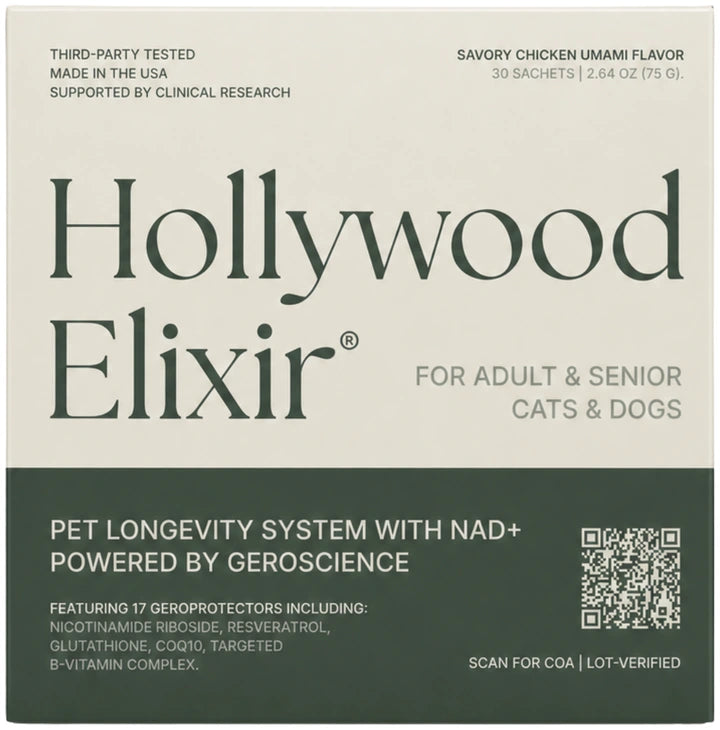
Hollywood Elixir is our daily supplement for adult and senior cats, made to the LPL-01 standard with every active ingredient at a visible amount. It never replaces your veterinarian — it sits alongside the routine on this page.
Starting at $50/month · cancel anytime
Shop Hollywood ElixirWhen to Call the Vet
Split urgent signs from trends that deserve a scheduled veterinary conversation.
Go urgently
- Open-mouth breathing, labored breathing, blue or gray gums, collapse, seizure, sudden blindness, severe weakness, or rapid decline.
- Fainting, severe breathing effort, sudden hind-limb pain or paralysis, repeated vomiting with weakness, uncontrolled bleeding, or suspected toxin exposure.
- Repeated litter-box trips with little or no urine, straining with distress, blood in urine, or a painful abdomen.
Schedule promptly
- Weight loss or gain, appetite change, vomiting, increased thirst, larger urine clumps, constipation, diarrhea, or accidents.
- Greasy skin, redness, sores, coat thinning, ear odor, discharge, head shaking, pawing at ears, or grooming decline.
- Bad breath, drooling, dropped food, slower chewing, one-sided chewing, face sensitivity, or reduced grooming.
- Lower jumping, stiffness, poor squatting, less play, less shoulder-sitting or lap-seeking, hiding, irritability, or nighttime calling.
- Bring weight history, diet details, skin and ear notes, dental signs, litter observations, and safe videos of movement or breathing.
The 90-Day Support Routine
Ninety days of small, repeatable habits make subtle changes visible — and give any new routine a fair test.
- Week one: record weight, rib feel, meal pattern, thirst, litter clumps, skin feel, coat texture, ear appearance, dental breath, favorite perches, and normal social routes.
- Week one: take a calm photo of the coat and ears so future redness, debris, thinning, or greasiness has a comparison point.
- Weekly: check appetite, water, litter visits, breath, ear odor, skin comfort, grooming, jumping, and whether the Devon Rex still seeks people in its usual way.
- Monthly: repeat weight and body-condition notes, add one mobility observation, and mark skin, coat, dental, ear, appetite, and social changes.
- Day 90: review body condition, skin, coat, ears, dental comfort, kidney signs, breathing, movement, and quality of life with your veterinarian.
Tools for Tracking Comfort and Aging
Use these when a life-stage, body-condition, or quality-of-life question needs more structure.
Cat Age Calculator
Use age context when a social rex still acts young but the body is changing.
ToolCat Quality of Life Scale
Use when skin comfort, appetite, mobility, or social contact is shifting.
ToolCat Biological Age Calculator
Frame healthy-aging conversations around body condition and daily comfort.
Frequently Asked Questions
Short answers to the questions owners ask most.
What is a realistic Devon Rex lifespan?
Devon Rex lifespan planning should use about 9 to 15 years, then adjust for this cat's body condition, skin comfort, ears, dental health, movement, heart and kidney findings, and home routine.
Can Devon Rex cats live longer than 15 years?
Some can. A range is not a ceiling; genetics, accidents, dental care, body condition, pain control, indoor safety, and veterinary access can move one cat above or below it.
When should Devon Rex senior care start?
Devon Rex senior care should start before crisis. Use 10+ years as the senior marker and start baselines around 7 for weight, skin, coat, ears, dental signs, mobility, and social routines.
Which Devon Rex cat health problems matter most?
Devon Rex cat health problems that shape comfort include skin and coat irritation, ear problems, dental disease, HCM or breathing signs, kidney and urinary signs, mobility pain, weight change, and social withdrawal.
Which aging signs should Devon Rex owners watch?
Devon Rex aging signs include weight drift, greasy or irritated skin, coat thinning, ear odor, bad breath, lower jumping, poor grooming, appetite change, larger urine clumps, hiding, and less social engagement.
Does the rex coat need special senior care?
It needs gentle observation. Sudden skin redness, greasiness, sores, overgrooming, coat thinning, or touch sensitivity should be documented and discussed.
Are ear problems normal for Devon Rex cats?
Visible ears make checking easier, but odor, discharge, redness, scratching, head shaking, or pain is not something to normalize.
How does body condition affect Devon Rex healthspan?
Healthy body condition protects mobility, breathing margin, anesthesia safety, senior comfort, and skin-fold cleanliness. Use a veterinary body condition score rather than guessing from size.
What breathing signs are urgent?
Open-mouth breathing, blue or gray gums, collapse, severe breathing effort, or sudden weakness should be treated as urgent.
How often should an older Devon Rex see the vet?
Many senior cats benefit from at least twice-yearly check-ins, with timing adjusted to bloodwork, urinalysis, blood pressure, dental findings, heart concerns, pain, weight, and new signs.
What should I ask a breeder or rescue?
Ask about lifespan, early deaths, HCM, PKD, hip or kneecap problems, dental history, skin and coat issues, ear problems, appetite, mobility, and social behavior.
Is Hollywood Elixir something my Devon Rex needs?
No supplement is a need. Hollywood Elixir is La Petite Labs' daily supplement for adult and senior cats, not a treatment for anything on this page.
A note from La Petite Labs
Hollywood Elixir is La Petite Labs' daily supplement for adult and senior cats. It is not a treatment for anything on this page, and it never replaces your veterinarian.

Why Pampered belongs in a Devon Rex 90-day plan
Pampered is La Petite Labs' complete daily system, with a recommended 90-day starting window. For a Devon Rex household, it can sit beside this page's recording weight, rib feel, meal pattern, thirst, litter clumps, skin feel, coat texture, ear appearance, dental breath, favorite and repeating weight and body-condition notes, add one mobility observation, and mark skin, coat, dental, ear, appetite, and social, keeping skin and coat, ears, dental, and body condition in the day-90 conversation.
Explore the Pampered™ System →