



Border Collie lifespan and senior care
How Long Do Border Collies Live?
12–15Years, typical
Border Collie lifespan planning starts with a dog that may keep working through pain, vision change, seizures, stiffness, or mental stress.
- Start watching at
- From 7-8 years
- Senior age
- Around 9-11 years
- Typical lifespan
- 12-15 years
Border Collie lifespan and Border Collie health problems planning: A practical active-herding range; epilepsy, eye disease, orthopedic pain, body condition, recovery, injuries, and veterinary care change the path for one dog.
Quick Answers for Pet Parents
Direct answers to the questions people ask when they are trying to plan care.
How long do Border Collies live?
Most Border Collies are planned around 12 to 15 years. Individual dogs vary with genetics, work level, injuries, epilepsy, eye health, body condition, accidents, and veterinary care.
When is a Border Collie considered senior?
Around 9 to 11 years is a sensible senior-planning window, but performance, recovery, and vision baselines should start around 7 to 8.
What health problems are Border Collies prone to?
Important Border Collie planning topics include epilepsy or seizure events, inherited eye disease, hip or orthopedic pain, injuries from intense activity, dental care, weight, and behavior changes from pain or under-stimulation.
What most affects a Border Collie healthspan?
Balanced exercise, lean body condition, eye and seizure monitoring, controlled recovery, pain care, safe sport decisions, and mental work that does not push through discomfort matter most.
What early aging signs matter in a Border Collie?
Watch slower turns, missed jumps, toe scuffing, reduced focus, new anxiety, seizure-like events, vision hesitation, longer recovery, stiffness after rest, and less ability to settle.
Lifespan at a Glance
The short answer with the context a careful pet parent needs.
| Typical lifespan | Plan around 12-15 years, then adjust for line, workload, seizures, eye history, injuries, and body condition. |
|---|---|
| Senior planning | Around 9-11 years; start recovery and gait baselines from 7-8 while the dog still looks athletic. |
| Earlier watchpoint | Track speed, turns, jump confidence, vision in dim light, seizure-like events, recovery, appetite, and restlessness. |
| Breed-specific priority | Drive can hide pain; a Border Collie may keep working when another dog would stop. |
| Household lever | A performance baseline: the same turn, jump, fetch, stair, or training cue repeated gently over time. |
| Do not ignore | Collapse, seizure clusters, sudden blindness, heat distress, repeated lameness, or a dog who cannot switch off. |

You can’t add sand to the glass. You can change what happens while it falls.
12-15 years is the range. What fills those years — lean condition, easy movement, steady digestion, good sleep — is built one ordinary day at a time.
Start the daily system → Starting at $50/month
If your Border Collie still stares at the ball with full intensity but now turns wider, misses a catch in low light, takes longer to settle after work, scuffs a toe, or has had a strange collapse or seizure-like episode, the lifespan question is not about slowing this dog down. It is about making the work fit the body that has to keep doing it.
The direct answer: most Border Collies live about 12 to 15 years. That range is useful, but it is not the whole plan. A Border Collie can keep offering drive while eyes, joints, recovery, nerves, or mental stress are changing underneath.
This breed gives owners one advantage and one trap. The advantage is that performance is measurable: turns, jumps, stairs, focus, recovery, and sleep after a busy day. The trap is that the dog may keep working because work is rewarding, not because the body is fine.
If You Only Have Five Minutes
- Plan around 12 to 15 years, then adjust for line, activity, injuries, seizures, eyes, and body condition.
- Senior planning often becomes practical around 9 to 11, but start performance baselines around 7 or 8.
- A seizure-like event should be documented and discussed; clusters, prolonged episodes, collapse, heat distress, or poor recovery is urgent.
- Eye confidence matters: missed catches, dim-room hesitation, bumping, or sudden blindness needs attention.
- Repeated lameness, toe scuffing, slower turns, or reluctance to jump is not laziness in this breed.
- Teach and protect rest. A Border Collie who cannot switch off may be painful, stressed, under-stimulated, or overworked.
For comfort decisions, use the dog quality of life scale after an ordinary week, not after the most exciting outing. The dog biological age calculator can help frame when an athletic dog is entering senior territory.
Why Lifespan Numbers for Border Collies Don't Agree
Border Collie estimates vary because "Border Collie" covers pets, sport dogs, farm dogs, different lines, and different injury histories. A lightly active companion and a high-impact athlete may share a lifespan range while aging very differently.
The useful reading is that this is a medium-sized, often long-active dog with a real senior chapter to protect. Population numbers cannot tell you whether your dog can still jump safely, see well enough for the game, or recover from the work you ask for.
The dog lifespan methodology explains why ranges shift between sources. For this breed, the number should lead to measurement: video the gait, note the recovery, record the episode, and adapt the job before pain forces the change.
The goal is not to retire the mind. It is to keep the mind engaged while lowering avoidable impact.
What Shapes a Border Collie's Healthspan
Border Collie healthspan is shaped by epilepsy and episode response, eye health, orthopedic comfort, conditioning, recovery, mental welfare, dental care, and body condition.
Seizures and neurologic episodes
Border Collies are among breeds where epilepsy belongs in the owner conversation. A first seizure-like event should be timed, described, and discussed with a veterinarian.
If it is safe, film after the dog is protected from injury. Track duration, recovery, possible triggers, medications, toxins, and whether events cluster. Prolonged seizures, clusters, collapse, or poor recovery move the situation from notes to urgent care.
Eyes and working confidence
Inherited eye disease, cataracts, and retinal disease can change a working dog's confidence before the family sees obvious blindness. Missed catches, bumping, hesitation in dim rooms, dilated pupils, or anxiety in new spaces all matter.
Do not rearrange the house casually once vision is a question. Keep routes predictable and ask your veterinarian what screening or referral fits the signs.
Mobility and sports wear
Hips, shoulders, wrists, toes, back, and soft tissues all pay for speed and turns. A Border Collie may still sprint through discomfort, then show the truth at night or the next morning.
Watch the first steps after rest, tight turns, stair descent, jump takeoff, toe scuffing, and whether the dog chooses easier paths. A repeatable low-impact video is more useful than a heroic fetch session.
Screening history matters because hip dysplasia, early arthritis, old soft-tissue injuries, and collie eye anomaly can all change the plan before a family sees a dramatic crisis. Ask what was tested, what was only suspected, and what relatives experienced. For an older Border Collie, the practical question is not whether the dog still wants the task, but whether the joints and eyes still make that task fair.
Recovery after work
The important signal may appear after the fun. Longer panting, restless sleep, stiffness, irritability, lower appetite, or a dog who cannot settle can mean the session was too much.
Use rest days as training days. Scent work, trick work, shaping, and quiet problem-solving can preserve the brain while the body gets a kinder schedule.
Behavior and mental load
New anxiety, compulsive light or shadow chasing, irritability, clinginess, hiding, or inability to switch off can be pain, sensory change, stress, or unmet mental need.
Do not answer every behavior change with more exercise. Sometimes the most athletic dog in the house needs diagnostics, pain control, sleep, or different work.
Body condition and muscle
Lean muscle protects joints, but endless impact is not the only way to build it. Use controlled walks, varied surfaces, warmups, cooldowns, and body-condition targets.
At home, choose one performance baseline that is not extreme: a trot down the hall, a stair descent, a gentle turn around a cone, or a favorite low jump if approved. Repeat it monthly on video. The same task over time will show change before a dramatic injury does.
What Aging Looks Like in a Border Collie
Border Collie aging may look like slower turns, missed catches, toe scuffing, less clean jumping, longer warmups, heavier sleep after work, new anxiety, more barking, weight or muscle change, dental odor, seizure-like events, or a dog who still wants the cue but hesitates before the body follows.
Check the real baseline:
- Does the dog turn as tightly and comfortably as last season?
- Is recovery the same that evening and the next morning?
- Are eyes confident in dim light and unfamiliar spaces?
- Has focus changed, or is pain interrupting attention?
- Are there episodes, collapses, tremors, or confusion?
- Can the dog rest without constant management?
Normal aging can change intensity. It should not excuse seizure clusters, sudden blindness, repeated lameness, unmanaged pain, or a dog whose mind is frantic because the body cannot cope.
When to Call a Veterinarian
Go now for seizure clusters, a prolonged seizure, collapse, heat distress, blue-gray gums, sudden blindness, sudden inability to walk, severe pain after work, suspected spinal injury, repeated vomiting with weakness, toxin exposure, uncontrolled bleeding, or rapid decline.
Book a planned visit for a first seizure-like event, changed recovery, toe scuffing, repeated lameness, missed jumps, dim-light hesitation, eye cloudiness, new anxiety, weight or muscle change, dental odor, thirst change, or a dog who no longer settles normally.
Bring episode videos, gait clips, work schedule, surfaces, training changes, diet and treats, medication list, weight trend, eye observations, and a timeline. For older athletes, the most useful visit often starts with what the dog did yesterday and how the body looked this morning.
How Border Collies Compare With Similar Breeds
Border Collies overlap with Australian Shepherds and Australian Cattle Dogs on drive, eyes, seizures, and injury risk. Compared with Huskies, the endurance style differs; compared with toy breeds, the problem is rarely motivation and often restraint.
Use the dog lifespan by breed hub for the wider range comparison. For a Border Collie household, the more important comparison is whether the life still gives the dog work without making the body pay too much for it.
Questions for Your Breeder, Rescue, or Veterinarian
For a breeder or rescue:
- What seizure, eye disease, hip, elbow, shoulder, injury, dental, behavior, and lifespan history is known in relatives?
- What eye, hip, elbow, DNA, or other screening records are available?
- Has this dog had seizures, collapse, heat trouble, sports injuries, or vision concerns?
- What work, exercise, rest, and mental enrichment pattern has kept this dog stable?
For your veterinarian:
- What should we do after a first seizure-like event?
- Which eye signs need screening or referral?
- Is this lameness pain, weakness, conditioning, or injury?
- How should we change sport, fetch, stairs, jumping, and recovery days as the dog ages?
- At what age should lab work, dental scheduling, pain scoring, and comfort tracking become part of the yearly plan?
For a Border Collie with unknown history, start with eyes, episodes, gait, recovery, body condition, teeth, and the ability to settle. The dog may still want a job; the job can evolve.
Sources
- American Kennel Club. Border Collie breed information. https://www.akc.org/dog-breeds/border-collie/
- McMillan KM, Bielby J, Williams CL, Upjohn MM, Casey RA, Christley RM. Longevity of companion dog breeds: those at risk from early death. Scientific Reports. https://www.nature.com/articles/s41598-023-50458-w
- Creevy KE, Grady J, Little SE, et al. 2019 AAHA Canine Life Stage Guidelines. https://www.aaha.org/wp-content/uploads/globalassets/02-guidelines/canine-life-stage-2019/2019-aaha-canine-life-stage-guidelines-final.pdf
- VCA Animal Hospitals. Seizures General for Dogs. https://vcahospitals.com/know-your-pet/seizures-general-for-dogs
- VCA Animal Hospitals. Progressive Retinal Atrophy in Dogs. https://vcahospitals.com/know-your-pet/progressive-retinal-atrophy-in-dogs
- Orthopedic Foundation for Animals. CHIC Program breed health screening information. https://ofa.org/chic-programs/browse-by-breed/
Healthspan by Life Stage
Know what to track before senior age, not only after decline appears.
Build records and impulse control
Collect eye, hip, elbow, DNA, and family seizure history where available; teach rest as a skill, not just more work.
Condition the worker
Keep lean muscle, cross-train, protect joints, and record what normal focus, recovery, vision, and gait look like in ordinary routines.
Measure performance gently
Monthly videos of turns, stairs, jumping, and recovery help separate aging from pain, eye changes, overwork, or neurologic signs.
Keep the brain, reduce the impact
Use lower-impact enrichment, pain review, dental review, eye checks, bloodwork, and realistic sport or work modifications.
Let the mind matter
Judge movement, pain, sleep, appetite, toileting, anxiety, interest in work, and ability to settle together.
Breed Health Map
The main breed-specific topics that can shape lifespan, comfort, and quality of life.
Seizures and episode records
Any seizure-like event should be timed, filmed if safe, and discussed. Clusters, prolonged episodes, or poor recovery are urgent.
CEA, PRA, cataracts, and working confidence
Bumping, missed catches, dilated pupils, dim-light hesitation, or sudden blindness deserves veterinary attention.
Hips, shoulders, wrists, and sports wear
Repeated lameness, slower turns, toe scuffing, shorter jumping, or stiffness after rest should not be dismissed as age.
Drive can overrule pain
A Border Collie may keep going because the task is rewarding. Watch the evening after activity, not only the activity itself.
Restlessness, pain, and under-stimulation
New anxiety, irritability, compulsive behavior, or inability to settle can reflect pain, sensory change, stress, or unmet mental needs.
Lean muscle without overwork
This breed needs muscle, not extra weight and not endless high-impact work. Ribs, waist, and thigh strength matter.

One serving a day, built for aging dogs
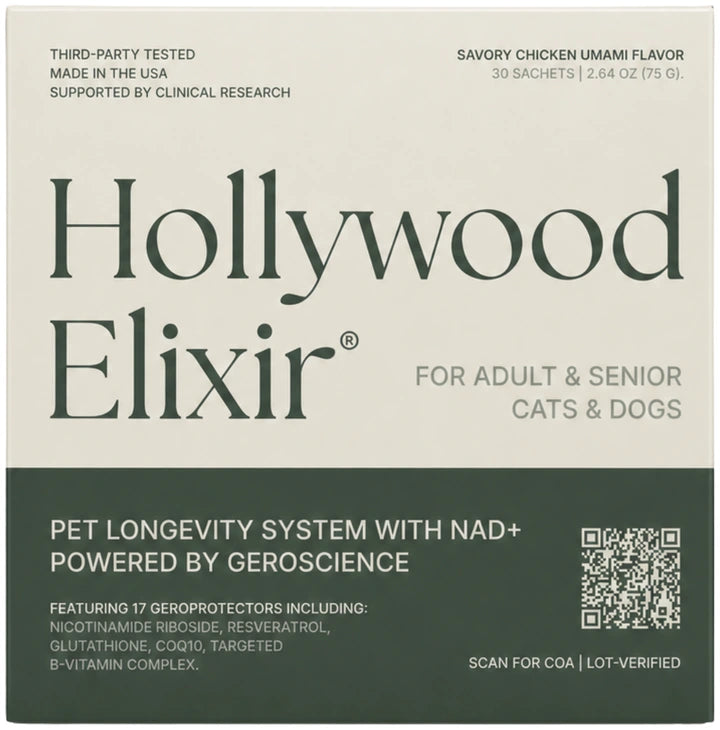
Hollywood Elixir is our daily supplement for adult and senior dogs, made to the LPL-01 standard with every active ingredient at a visible amount. It never replaces your veterinarian — it sits alongside the routine on this page.
Starting at $50/month · cancel anytime
Shop Hollywood ElixirWhen to Call the Vet
Split urgent signs from trends that deserve a scheduled veterinary conversation.
Go urgently
- Seizure clusters, a seizure lasting several minutes, collapse, heat distress, blue-gray gums, or poor recovery after an episode.
- Sudden blindness, severe eye pain, sudden inability to walk, severe pain after work, or suspected spinal injury.
- Repeated vomiting with weakness, uncontrolled bleeding, toxin exposure, severe disorientation, or rapid decline.
Schedule promptly
- A first seizure-like event, changed episode pattern, confusion afterward, or new nighttime restlessness.
- Bumping, missed catches, dim-light hesitation, eye cloudiness, or sudden reluctance on stairs.
- Limping, toe scuffing, slower turns, lower jump confidence, stiffness after rest, or reduced recovery.
- Weight change, reduced muscle, dental odor, appetite change, thirst change, or lower stamina.
- New anxiety, compulsive shadow chasing, irritability, hiding, or inability to settle after normal work.
The 90-Day Support Routine
Ninety days of small, repeatable habits make subtle changes visible — and give any new routine a fair test.
- Week one: film a calm trot from the side and behind, a favorite low-impact cue, a stair descent, and normal recovery after a familiar outing.
- Week one: write the dog normal work rhythm: duration, surface, rest breaks, appetite after activity, sleep that night, and mental enrichment.
- Weekly: watch turns, toe placement, jump choices, eye confidence, episode-like events, mouth odor, and whether the dog can settle after stimulation.
- Monthly: repeat gait and recovery videos, weight and muscle notes, vision observations in dim light, and any seizure or collapse timeline.
- Day 90: review sport level, pain plan, eye or seizure workups, dental timing, body condition, and lower-impact enrichment with your veterinarian.
Tools for Tracking Comfort and Aging
Use these when a life-stage, body-condition, or quality-of-life question needs more structure.
Dog Quality of Life Scale
Use when drive hides pain and the family needs a calmer comfort score.
ToolDog Biological Age Calculator
Frame senior timing for an athletic dog whose mind may stay younger than the joints.
ToolDog Body Condition Calculator
Keep the working dog lean without guessing from activity level alone.
Frequently Asked Questions
Short answers to the questions owners ask most.
What is the average Border Collie life expectancy?
A practical planning range is 12-15 years. Workload, injuries, epilepsy, eye disease, body condition, accidents, and veterinary care can move one dog around it.
Can a Border Collie live longer than 15?
Some do. The useful goal is preserving comfortable movement, safe vision, seizure control when needed, good sleep, and meaningful low-impact work.
Is 10 old for a Border Collie?
Ten is a reasonable senior-planning age, but recovery, gait, and vision baselines should start earlier while the dog still looks athletic.
Do Border Collies get epilepsy?
They can. Any seizure-like event deserves a veterinary discussion, and clusters, prolonged seizures, collapse, or poor recovery are urgent.
What eye problems matter in Border Collies?
Inherited eye disease, cataracts, and retinal disease are part of the breed conversation. Bumping, dim-light hesitation, cloudiness, or sudden blindness should be checked.
Why is my older Border Collie slowing down?
Slowing may be age, but it can also be pain, eye change, heart or endocrine disease, dental pain, overwork, or neurologic disease. Compare against baseline videos.
How much exercise does a senior Border Collie need?
Enough to maintain muscle and mental health without repeatedly causing soreness. Lower-impact training, scent work, and shorter sessions often age better than endless fetch.
What signs mean my Border Collie should see a vet soon?
Book for repeated lameness, slower turns, toe scuffing, eye changes, seizure-like events, weight or thirst change, dental odor, or behavior that no longer fits.
How often should a senior Border Collie see the vet?
Twice yearly is a useful default once senior planning begins, with pain, dental, bloodwork, eye, seizure, and activity review tailored to the dog.
What should I bring to a Border Collie senior visit?
Bring gait videos, recovery notes, episode videos, work schedule, surface details, diet, medications, weight trend, eye observations, and a timeline.
Can mental work replace physical work for an older Border Collie?
It can replace some impact, not all movement. The best plan protects muscle, joints, sleep, and the dog need to think.
Is Hollywood Elixir something my Border Collie needs?
No supplement is a need. Hollywood Elixir is La Petite Labs daily supplement for adult and senior dogs, and it is not a treatment for problems on this page.
A note from La Petite Labs
Hollywood Elixir is La Petite Labs' daily supplement for adult and senior dogs. It is not a treatment for anything on this page, and it never replaces your veterinarian.

Why Pampered for a Border Collie household
Pampered is La Petite Labs' complete daily system, with a recommended 90-day starting window. The Border Collie routine here is specific: filming a calm trot from the side and behind, a favorite low-impact cue, a stair descent, and normal and return to epilepsy, eyes, mobility, and recovery, so Pampered belongs beside those notes instead of replacing them.
Explore the Pampered™ System →