

The 12 Hallmarks of Aging in Dogs, Explained
Read full insightLongevity15 vs Hollywood Elixir® for Dogs
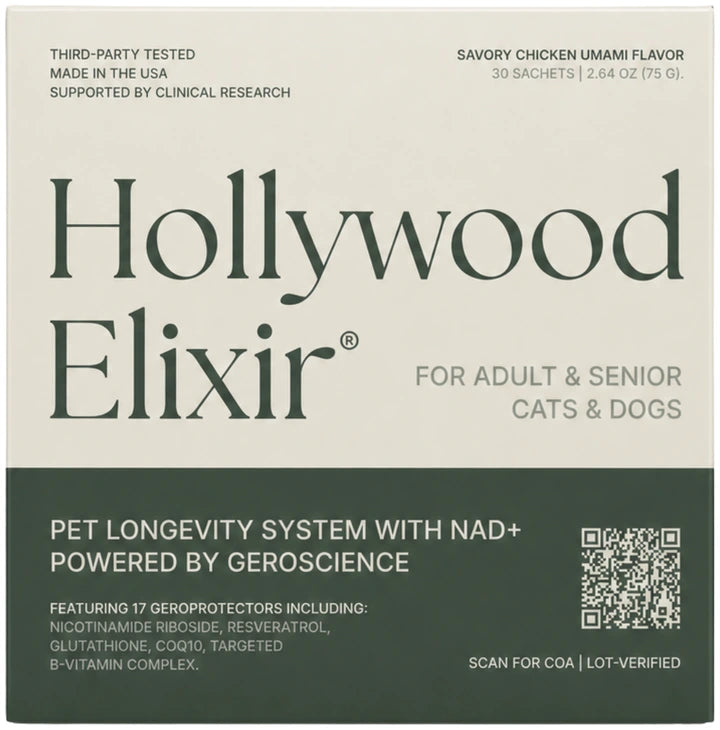
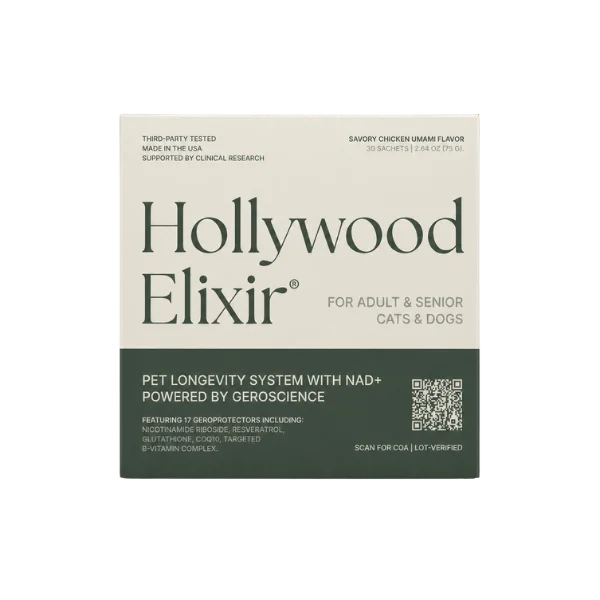
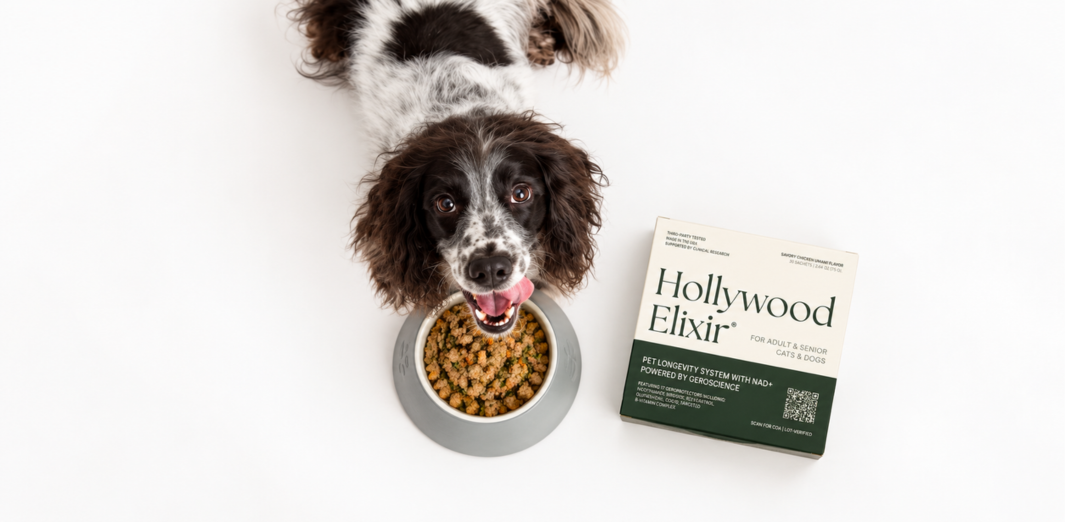
Longevity15 makes one C15:0 idea very easy to give. Hollywood Elixir® gives senior-dog owners a broader food-mixed routine with printed amounts, lot-level quality lookup, and fewer dose questions before day one.
By La Petite Labs Editorial 13 min read

At a Glance
What is Longevity15 for dogs?
Longevity15 is a daily dog supplement from Pet’s Best Life built around FA15, pentadecanoic acid, also called C15:0. It uses pre measured packets given once daily at mealtime. Its strength is a clean single active idea; its main caution is that the public label does not state the C15:0 milligrams per sachet.
Product
Longevity15 Powered by fatty15 C15:0 Health Supplement for Dogs
Category
Dog longevity supplement
Format
Pre-measured daily sachets; one packet per day at mealtime with dog-size bands.
Why owners notice it
A single-active C15:0 dog supplement using FA15/pentadecanoic acid in a food-sprinkle packet.
What to check
The active identity is named as FA15/pentadecanoic acid/C15:0 with a purity claim above 99.5%. The public label does not state the milligrams of C15:0 per sachet, and no public lot-level COA Lookup is easy to find.
Side by Side
The Plain Comparison
**The Plain Comparison**
| question | competitor | lpl | winner |
|---|---|---|---|
| Main idea | One active identity: FA15 / pentadecanoic acid / C15:0. | Multi-active daily longevity support across NAD+, antioxidant, mitochondrial, immune, phytonutrient, and light protein lanes. | Hollywood Elixir for broader senior-dog support; Longevity15 for C15:0 curiosity. |
| Active dose visibility | C15:0 is named, but the public label does not state the milligrams per sachet. | Named actives are printed in milligrams, including nicotinamide riboside 60 mg and CoQ10 40 mg. | Hollywood Elixir |
| Daily format | Excellent usability: one pre-measured packet per day at mealtime with dog-size bands. | Food-mixed powder sachet that can be introduced gradually and paused cleanly. | Hollywood Elixir for a broader readable routine; Longevity15 for the simplest packet. |
| Evidence posture | Underlying C15:0 research is substantial, but no published finished-product dog trial was found in the current public details. | Evidence-informed supplement support with careful claim boundaries, not a superiority or lifespan claim. | Hollywood Elixir for clearer expectations; Longevity15 for owners following C15:0 research. |
| Quality check | cGMP and purity language appear, but no named lab, public COA, NASC seal, or batch lookup is easy to find. | COA Lookup gives owners a place to check lot-level quality information. | Hollywood Elixir |
| Cost | $54.99 for a 30-count box on the brand site; bundle offers listed. | From $89 one-time; 90-sachet one-time pack $199; 90-day subscription plan $189 ($63/mo). | Hollywood Elixir for routine depth; Longevity15 for lower single-active entry cost. |

The Genuine Appeal of a Single-Active Sachet

The Label, Walked Through Carefully

What Is Not Visible Before Buying

Format and Daily-Routine Reality
What Hollywood Elixir Actually Is

Active Amounts Side by Side

Quality and Testing Access

Evidence Status on Both Sides

Price and 90-Day Routine Value

Who Should Choose Longevity15

How to Read Any Single-Active Longevity Label

Preparing for the Veterinarian Conversation
Product facts, public claims, ingredient details, and quality-language checks were checked against the references below.
- Source Official Longevity15 brand site Used for product name, C15:0 positioning, format, weight bands, ingredient identity, inactive ingredients, pricing, and manufacturing language.
- Source Longevity15 launch announcement Used for Pet’s Best Life and fatty15 partnership context.
- Source Pet Age Longevity15 trade article Used for brand-described C15:0 pathway framing and evidence posture.
- Source Pet Innovation Awards announcement for Longevity15 Used for purity and award-positioning context.
- Source Dog Dish Longevity15 listing Used for retailer corroboration of product format and pricing context.
- Source Chewy Longevity15 listing Used for mass-retail distribution and format context.

Discover LPL-01: How This Fits Into a Larger Canine Longevity System
Aging in dogs is not driven by a single pathway. It’s the result of interacting biological systems—energy metabolism, oxidative stress, immune signaling, and structural integrity—changing over time.
This article explores one piece of that puzzle. If you want to understand how these pieces connect—and what actually moves the needle—you need to zoom out.
Start with the underlying science:
- Canine Geroscience Framework →
A structured view of how aging progresses across cellular energy, inflammation, and resilience systems. - Senior Biological Defense Coverage (BDC) Modeling →
A systems-level map of which biological pathways decline first, and how layered interventions can support them. - Canine Geroscience Evidence System →
A breakdown of what is strongly supported in the literature versus what is still emerging. - LPL-01 Standard →
The formulation system that translates these models into real-world supplementation—covering multiple pathways in a coordinated way.


